
The Journal
The 14 Hallmarks of Aging: A Protocol Built for All 14
Nine, then twelve, now fourteen

In 2013, a group of researchers led by Carlos López-Otín did something the field had never managed. They wrote down what aging actually is. Nine processes, each one measurable, each one shown to speed aging when pushed and slow it when eased. They called them the Hallmarks of Aging, and the paper became one of the most cited in biology.
Ten years later, the same team expanded the list to twelve. Disabled autophagy, chronic inflammation and gut dysbiosis had earned their place. We covered those twelve in our complete guide to the hallmarks.

Then, in 2025, López-Otín and Guido Kroemer added two more. The thirteenth is changes to the extracellular matrix, the collagen scaffold that holds every tissue together. The fourteenth is psychosocial isolation. For the first time, the people who defined aging at the molecular level put loneliness on the same list as DNA damage.
That fourteenth hallmark changes what a longevity protocol has to be. A capsule cannot reach it. So this article walks through all fourteen, one by one, and shows how the TimeWarp Longevity Protocol addresses each: which compounds in the formula act on it, and which habit in the companion app reinforces it.
Why coverage matters more than any single compound
The hallmarks are not a checklist. They are a network. Damage to DNA drives epigenetic drift. Epigenetic drift disables the genes that clear senescent cells. Senescent cells pump out inflammation. Inflammation damages DNA. Every hallmark feeds at least two others.

That is why a compound that acts on one hallmark has a ceiling. It cannot stop the others from pushing. It is also why we built Protocol 01 the way we did: 240 compounds screened, 25 kept, chosen for how much of the map they cover together rather than how impressive any one of them looks alone. Then we built the app around the hallmarks no compound can reach.
The fourteen hallmarks, and what addresses each one
The hallmarks fall into three groups. Primary hallmarks are the original damage. Antagonistic hallmarks are the body’s responses, which help at first and then backfire. Integrative hallmarks are the body-wide consequences. The two newest sit outside the cell entirely.

For each hallmark below: what it is, which Protocol 01 compounds act on it, and which app habit supports it. Compound effects describe mechanism and human research on the ingredients.
Primary hallmarks: the original damage

1. Genomic instability. DNA accumulates damage from radiation, chemicals and its own copying errors. Repair enzymes keep pace when you are young and fall behind as you age. In the formula: NMN, because the repair enzymes called PARPs consume NAD to work. Sulforaphane (from glucoraphanin and myrosinase), which switches on the cell’s own detoxification defenses. Magnesium, a required cofactor for DNA repair enzymes. Folate and B12, which supply the building blocks for new DNA. In the app: A steady sleep window. DNA repair runs hardest during deep sleep.


2. Telomere attrition. The protective caps on your chromosomes shorten with every cell division. When they run out, the cell stops dividing or dies. In the formula: Cycloastragenol, one of the few compounds shown to activate telomerase, the enzyme that rebuilds telomeres. In a one-year randomized trial, telomeres grew while the placebo group’s shortened. Vitamin D3, which slowed telomere loss by about three years’ worth over four years in the 1,031-person VITAL trial. In the app: A daily movement target. Physically active adults have longer telomeres across many population studies.


3. Epigenetic alterations. The chemical tags that tell each cell which genes to read drift out of place with age. This drift is what epigenetic clocks measure. In the formula: Ca-AKG, the molecule the tag-erasing enzymes (TETs) depend on. In a 42-person study, epigenetic age fell an average of 8 years. 5-MTHF, methylcobalamin and B6, which supply the methyl groups the tags are made of. Vitamin D3, which lowered epigenetic age 1.9 years in 16 weeks in a randomized trial. EGCG, which acts on the enzymes that write the tags. In the app: Sleep regularity. Short and irregular sleep track with faster epigenetic aging even in healthy young adults.


4. Loss of proteostasis. Proteins misfold and clump, and the systems that refold or clear them wear out. This is the process behind protein buildup in the aging brain and muscle. In the formula: Spermidine, which drives autophagy, the clearance of damaged proteins. Rhodiola, which supports the heat-shock proteins that refold damaged ones. EGCG and curcumin, both studied for their action against protein aggregation. In the app: Movement. Exercise is one of the strongest known triggers of protein quality control in muscle and brain.


5. Disabled macroautophagy. The cell’s recycling system slows with age, so worn-out parts pile up instead of being broken down and reused. In the formula: Spermidine, the most-studied dietary autophagy inducer. Dihydroberberine, which activates AMPK, the energy sensor that switches autophagy on. In the app: The post-meal walk and movement snacks. Exercise activates the same AMPK switch.

Antagonistic hallmarks: responses that backfire

6. Deregulated nutrient sensing. The pathways that sense food (insulin, mTOR, AMPK, sirtuins) stay switched to “grow” long after growing has stopped being useful. In the formula: Dihydroberberine, which activates AMPK and improved fasting glucose in human trials. Pterostilbene, which supports sirtuin activity. Ca-AKG, which acts on mTOR signaling. In the app: The post-meal walk, which blunts the glucose spike after eating, and a consistent eating rhythm.


7. Mitochondrial dysfunction. The cell’s power plants produce less energy and more damaging byproducts as they age. In the formula: NMN, which raises NAD, the molecule mitochondria run on. Ca-AKG, a direct fuel for the mitochondrial energy cycle. Magnesium, required for every ATP-using reaction. In the app: The movement target and Zone 2 sessions. Endurance exercise is the strongest known stimulus for building new mitochondria.


8. Cellular senescence. Damaged cells stop dividing but refuse to die, and leak inflammatory signals that age their neighbors. In the formula: The monthly Senolytic Cleanse: liposomal fisetin, the most potent senolytic of ten plant compounds screened by the Mayo Clinic, paired with isoquercetin. Apigenin, which supports the immune surveillance that clears senescent cells. In the app: The monthly Cleanse reminder, so the two-day pulse actually happens.

Protocol 01 · Launching Fall 2026
Reverse. Slow. Protect. Protocol 01 is built on compounds with evidence for all three, in one daily system.
Join the Founding ListIntegrative hallmarks: the body-wide consequences

9. Stem cell exhaustion. The reserve cells that repair tissue run low or stop responding. In the formula: NMN, because stem cell function depends on NAD availability. Cycloastragenol, which activates telomerase, the enzyme that keeps dividing cells renewing. In the app: Strength training. Loading muscle is the signal that recruits its stem cells.


10. Altered intercellular communication. The signals cells send each other, through hormones, nerves and immune messengers, become noisy and inflammatory. In the formula: Apigenin, which inhibits CD38, the enzyme that drains NAD during immune signaling. Curcumin, which acts on NF-κB, the master switch for inflammatory signaling. Rhodiola, which steadies the stress-hormone axis. In the app: Guided breathwork and the evening wind-down, which lower the stress signaling that drives inflammatory crosstalk.


11. Chronic inflammation. Low-grade inflammation that never switches off, often called inflammaging. It sits upstream of nearly every other hallmark. In the formula: Liposomal curcumin, which lowered CRP and IL-6 in human trials. Sulforaphane, vitamin D3, EGCG and apigenin, each with human data on inflammatory markers. Urolithin A, a postbiotic studied for its effect on aging immune cells. Fisetin, which clears the senescent cells that produce inflammation. In the app: Sleep and movement. Both are among the strongest non-drug levers on inflammatory markers in people.


12. Dysbiosis. The gut microbiome shifts with age toward species that promote inflammation and away from those that protect the gut lining. In the formula: Glucoraphanin, which the gut converts to sulforaphane. Dihydroberberine, which reshapes gut bacterial populations in human studies. EGCG and curcumin, polyphenols that feed protective species. In the app: Outdoor morning light and a regular eating rhythm, which keep the gut’s own circadian clock in step.

The two beyond the cell

13. Extracellular matrix changes. The collagen and elastin scaffold around your cells stiffens, fragments and cross-links with age. Stiff arteries, wrinkled skin and fragile tendons are all matrix problems. In the formula: Vitamin C, which collagen cannot be built without. Vitamin K2, which activates the proteins that keep calcium out of soft tissue. Sulforaphane, which acts on the enzymes that break the matrix down. In the app: Strength training. Loading is the primary signal that keeps tendon, bone and connective tissue rebuilding.


14. Psychosocial isolation. The newest hallmark, and the only one with no molecular fix. In 334,415 UK Biobank adults, loneliness and isolation raised the odds of accelerated biological age, and that acceleration explained part of the higher death rate among the isolated. In the formula: Nothing. No compound reaches it. In the app: Connection, as a daily Foundation habit alongside sleep, movement and mind. The app is built to be shared: each protocol includes access for two adults in a household, so the routine itself becomes a point of contact.

Protocol 01 · Launching Fall 2026
25 compounds. One system. Engineered to target aging at the cellular level.
Request early accessWhy the app is not an accessory
Look back at the fourteen. Five of them (telomeres, epigenetics, mitochondria, stem cells, the matrix) respond to exercise about as strongly as to any compound. Two of them (psychosocial isolation, and much of chronic inflammation) respond to habits and to nothing else. That is not a reason to skip the compounds. It is a reason the compounds alone were never going to be a complete answer.

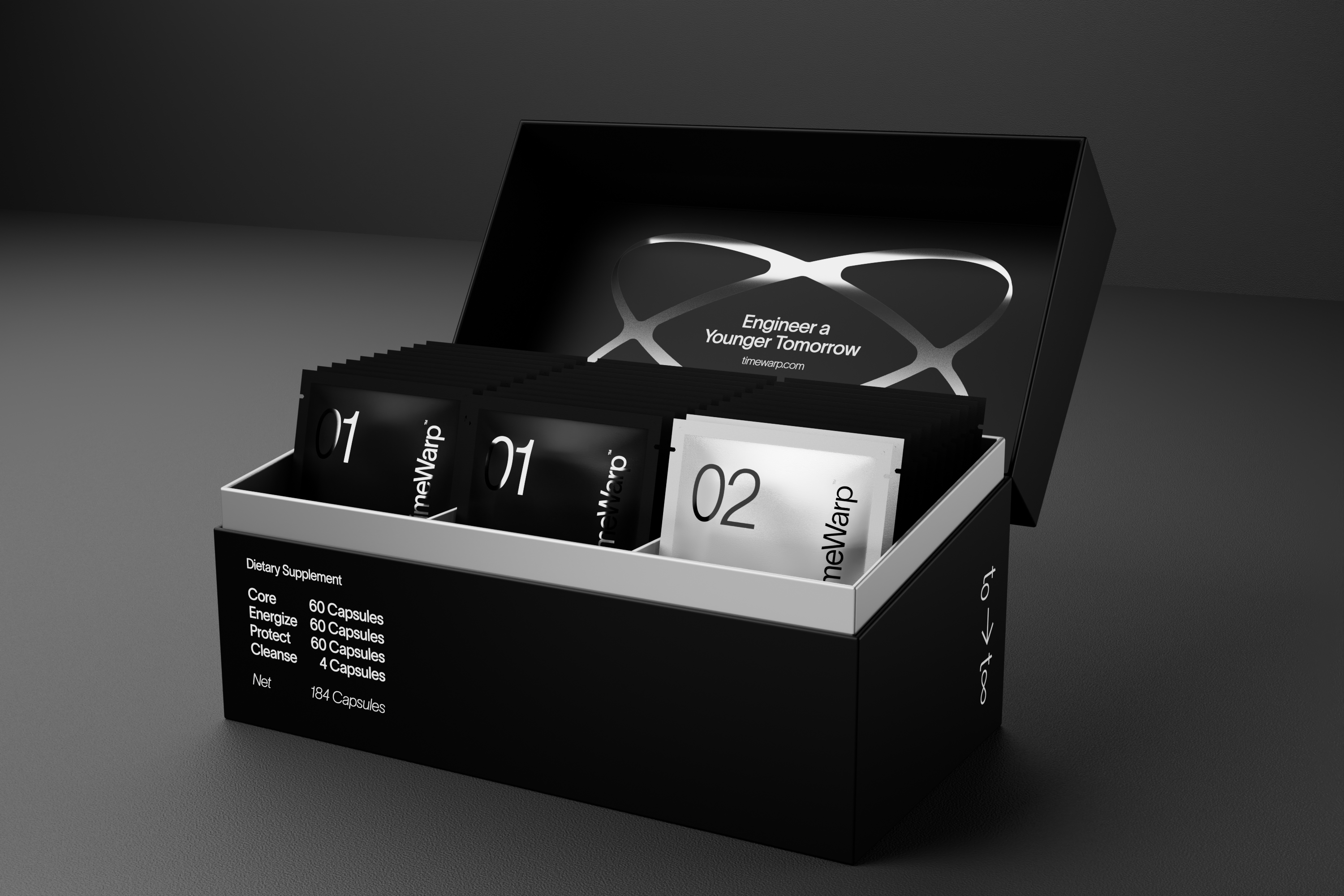
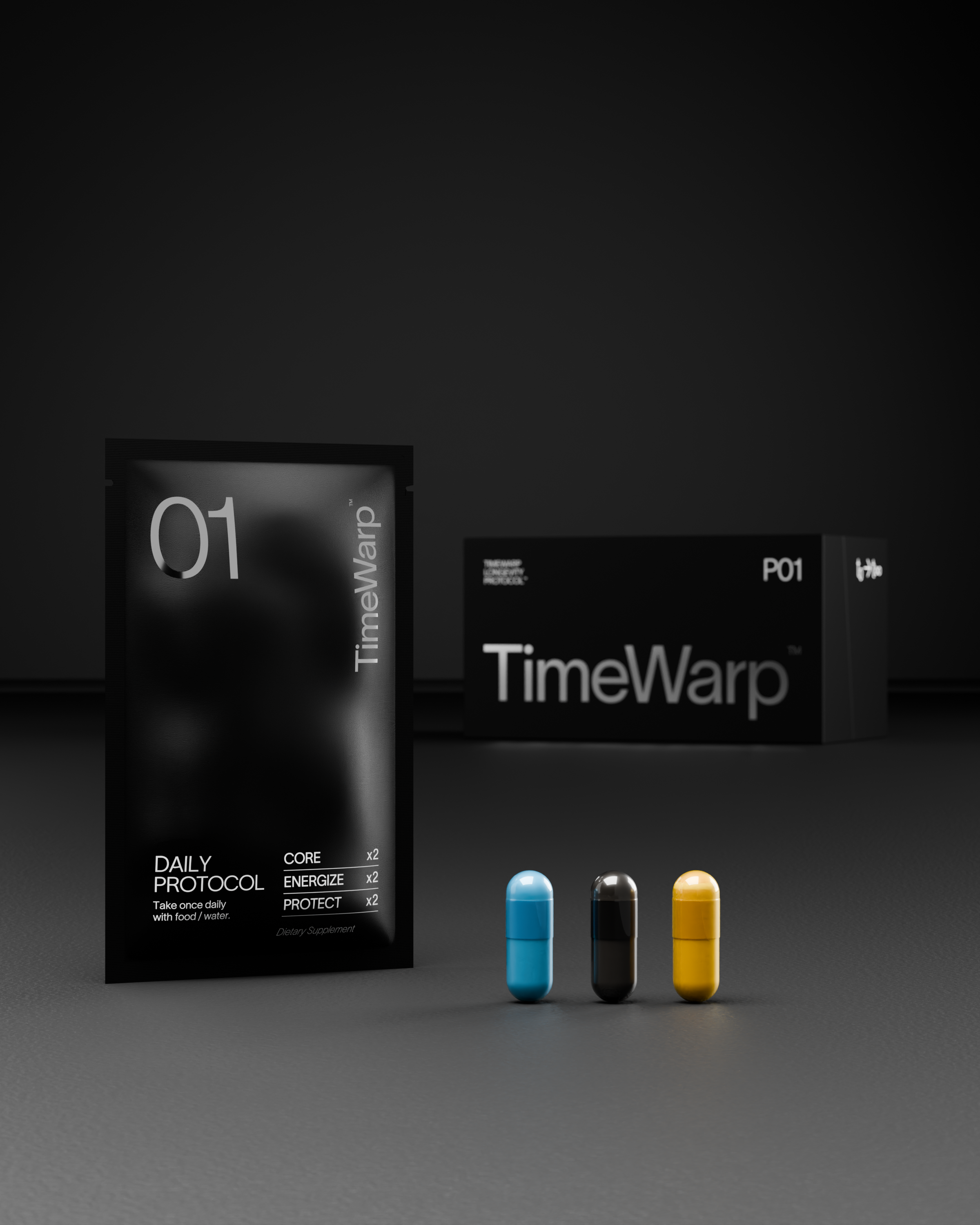
So the app ships with every protocol, at no extra cost. It logs the sachet, reminds you of the monthly Cleanse, and runs a short list of Foundation habits at the right time of day. Morning light and a movement target. A post-meal walk. Breathwork and a wind-down at night. Connection. And it tracks your biological age over time, starting with a built-in lifestyle quiz, with the option to import lab results you already have.
The bottom line

Fourteen hallmarks. Twenty-five compounds covering the twelve inside the cell, most of them touching several. A companion app covering the two beyond it, and reinforcing the rest. The first longevity system built for all fourteen.
FOUNDER'S EDITION
Engineer a younger tomorrow.
Protocol 01 opens to a founding group in Fall 2026. Request your place.
$249/month · billed quarterly · about $8.30/day
FOUNDING ACCESS
You're in.
You're now on the Protocol 01 Founder's Edition waitlist. Check your inbox for your confirmation and what comes next.
Want launch alerts by text?
Your place is already secured. Add your mobile number only if you also want text updates.
Protocol 01 launches Fall 2026. You'll be among the first to hear when access opens.
Frequently asked questions

What are the 14 hallmarks of aging? The twelve hallmarks defined in 2023 (genomic instability, telomere attrition, epigenetic alterations, loss of proteostasis, disabled macroautophagy, deregulated nutrient sensing, mitochondrial dysfunction, cellular senescence, stem cell exhaustion, altered intercellular communication, chronic inflammation and dysbiosis) plus two added in 2025: extracellular matrix changes and psychosocial isolation.
Who added the two new hallmarks? Carlos López-Otín and Guido Kroemer, the scientists behind the original 2013 and 2023 frameworks, in a 2025 paper on precision geromedicine.
Can a supplement address psychosocial isolation? No. It is the one hallmark no compound reaches. That is why the TimeWarp Longevity Protocol includes a companion app with a daily connection habit, and why we say the protocol is a system rather than a supplement.
Does one compound address several hallmarks? Yes. NMN appears under genomic instability, mitochondria and stem cells. Sulforaphane under genomic instability, inflammation, dysbiosis and the matrix. That overlap is deliberate: compounds that reach several hallmarks were ranked higher in our screen.
Is Protocol 01 a drug? No. It is a dietary supplement. These statements have not been evaluated by the Food and Drug Administration. This product is not intended to diagnose, treat, cure, or prevent any disease.
Sources
- López-Otín C. et al. The Hallmarks of Aging. Cell, 2013.
- López-Otín C. et al. Hallmarks of aging: An expanding universe. Cell, 2023. https://www.cell.com/cell/fulltext/S0092-8674(22)01377-0
- López-Otín C., Kroemer G. Hallmarks of aging: Integrating molecular and social determinants. Geromedicine, 2025. https://www.sciexplor.com/geromedicine/articles/Geromedicine.2025.0007
- Loneliness, social isolation, and biological aging in older adults: UK Biobank and NHANES III. https://bb30.ndph.ox.ac.uk/ukb/pub.cgi?id=18201
- Demidenko O. et al. Rejuvant and biological aging. Aging, 2021. https://www.aging-us.com/article/203736/text
- Chen L. et al. Vitamin D3 supplementation and epigenetic aging. Journals of Gerontology, 2019. https://pmc.ncbi.nlm.nih.gov/articles/PMC6612014
- Zhu H. et al. Vitamin D3 and leukocyte telomere length: VITAL. American Journal of Clinical Nutrition, 2025.
- Salvador L. et al. A natural product telomerase activator lengthens telomeres in humans. Rejuvenation Research, 2016. https://pmc.ncbi.nlm.nih.gov/articles/PMC5178008/
- Yousefzadeh M.J. et al. Fisetin is a senotherapeutic that extends health and lifespan. EBioMedicine, 2018. https://pmc.ncbi.nlm.nih.gov/articles/PMC6197652
- Garatachea N. et al. Exercise attenuates the major hallmarks of aging. Rejuvenation Research, 2015. https://pmc.ncbi.nlm.nih.gov/articles/PMC4340807/


